
Research > Instruments
Electroencephalography
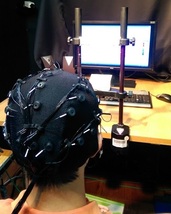
Electroencephalography (EEG) is the recording of electrical activity along the scalp. EEG measures voltage fluctuations resulting from ionic current flows within the neurons of the brain. In clinical contexts, EEG refers to the recording of the brain's spontaneous electrical activity over a short period, usually 20–40 minutes, as recorded from multiple electrodes placed on the scalp. Diagnostic applications generally focus on the spectral content of EEG, that is, the type of neural oscillations that can be observed in EEG signals.
References:
References:
- Wikipedia. http://en.wikipedia.org/wiki/Electroencephalography
- Tatum IV, William O. (2014). Handbook of EEG interpretation: Demos Medical Publishing.
- Ullsperger, Markus, & Debener, Stefan. (2010). Simultaneous EEG and fMRI: recording, analysis, and application: Oxford University Press.